
The cloud market is bigger and more crowded than ever.
AWS, Azure, and Google Cloud still dominate. But plenty of independent and regional cloud providers are worth a serious look depending on your workload, budget, and where your data needs to live.
Worldwide cloud infrastructure spending hit $107 billion in Q3 2025 alone. The big three control about 63% of that. The remaining 37% is where most businesses actually find their best fit.
Below are the 13 best cloud service providers in 2026, what each one is good at, and who should use them.
Quick Comparison
|
# |
Provider |
Best For |
|
1 |
Amazon Web Services (AWS) |
Enterprise scale, broadest service catalog, deepest compliance |
|
2 |
Microsoft Azure |
Microsoft ecosystem and hybrid cloud architectures |
|
3 |
Google Cloud Platform (GCP) |
AI, machine learning, and large-scale data analytics |
|
4 |
ServerMania (AraCloud) |
Performance-focused workloads without hyperscaler complexity |
|
5 |
Alibaba Cloud |
Asia-Pacific operations and Chinese market access |
|
6 |
IBM Cloud |
Regulated industries and Red Hat-based hybrid cloud |
|
7 |
Oracle Cloud (OCI) |
Oracle Database workloads and Always Free tier prototyping |
|
8 |
Tencent Cloud |
China market access and gaming infrastructure |
|
9 |
DigitalOcean |
Startups, developers, and small businesses |
|
10 |
Vultr |
Global low-latency hosting with bare metal and GPU options |
|
11 |
Linode (Akamai) |
Predictable cloud experience with Akamai edge integration |
|
12 |
OVHcloud |
European data sovereignty and GDPR-strict workloads |
|
13 |
Dell Technologies Cloud |
On-premises hybrid cloud with VMware |
1. Amazon Web Services (AWS)
Best for: Enterprise scale and the broadest cloud service portfolio
AWS is the cloud market leader. It holds about 29% of the global cloud infrastructure market in Q3 2025, more than the next two providers combined.
With over 200 fully managed services, 39 geographic regions, and 123 availability zones, it’s the default choice for large enterprises.
The breadth is genuinely impressive. EC2 covers virtual machines, Lambda handles serverless, S3 sets the industry standard for object storage at 11 nines of durability, and SageMaker plus Bedrock cover the AI and ML stack.
Compliance is another standout. AWS holds more security and regulatory certifications than any other cloud provider on this list.
The trade-off is operational complexity. AWS pricing is famously hard to forecast, with compute, storage, networking, and data transfer fees stacking across hundreds of services.
Most teams running AWS at scale need a dedicated FinOps practice just to keep the monthly bill predictable. The learning curve is steep, and IAM alone can consume weeks for new teams.
Key features:
- 200+ managed cloud services across compute, storage, networking, AI/ML, and databases
- 39 regions and 123 availability zones, the largest global footprint of any cloud provider
- Amazon S3 with 99.999999999% durability for object storage
- Industry-leading AI/ML stack: SageMaker, Bedrock, Rekognition, Comprehend
- Most extensive enterprise compliance portfolio (FedRAMP, HIPAA, PCI DSS, ISO 27001, SOC 1/2/3)
- Deep partner ecosystem and the largest pool of certified cloud engineers in the industry
Best for: Large enterprises, AI/ML-intensive workloads, organizations with dedicated cloud teams.
2. Microsoft Azure
Best for: Organizations already running Microsoft infrastructure
Microsoft Azure holds about 20% of the cloud infrastructure market and grew 33% year-over-year in Q3 2025, faster than AWS.
Total Microsoft Cloud revenue hit $42.4 billion in Q3 alone, with AI services contributing 16 percentage points of Azure’s growth.
Azure’s edge is integration. If your business runs Microsoft 365, Active Directory, SQL Server, or Windows Server on-premises, Azure dramatically reduces migration friction compared to other cloud providers.
Azure Arc extends the management plane to on-premises infrastructure and other public clouds. That makes Azure the most mature option for hybrid cloud setups.
Beyond the Microsoft ecosystem, Azure offers a strong overall platform. Azure Virtual Machines support both Linux and Windows. Azure OpenAI Service provides direct access to GPT models. Azure Kubernetes Service (AKS) handles container orchestration.
The downsides mirror AWS. Pricing is complex, the portal can feel overwhelming, and support quality varies sharply depending on which tier you’re paying for.
Key features:
- Native integration with Microsoft 365, Teams, Dynamics 365, and Active Directory
- Azure Arc and Azure Stack for hybrid cloud and multi-cloud management
- Azure OpenAI Service with direct access to GPT-4 and other frontier models
- 60+ regions globally, the second-largest footprint after AWS
- Comprehensive compliance: FedRAMP High, HIPAA, PCI DSS, ISO 27001, IRAP
- Strong identity and access management via Microsoft Entra ID (formerly Azure AD)
Best for: Microsoft-centric enterprises, regulated industries, hybrid cloud transitions, .NET and SQL Server workloads.
3. Google Cloud Platform (GCP)
Best for: AI, machine learning, and data analytics
Google Cloud holds about 13% of the cloud infrastructure market and grew 34% in Q3 2025, the fastest growth rate of the big three.
Quarterly Google Cloud revenue hit $15.2 billion, driven primarily by AI infrastructure and generative AI offerings.
GCP’s biggest advantage is the underlying network. Google’s private global fiber backbone is the same infrastructure that powers Search, Gmail, and YouTube.
It delivers consistently low-latency data transfer between regions. For data-heavy workloads, this is a real differentiator over AWS and Azure.
The AI and analytics stack is genuinely best-in-class. BigQuery handles petabyte-scale data warehousing with serverless pricing. Vertex AI provides a unified ML platform from training through deployment.
TPUs (Tensor Processing Units) give Google Cloud customers access to custom silicon designed specifically for ML workloads.
Live VM migration during maintenance is another quiet win. Workloads keep running while Google patches the underlying hardware.
GCP’s main weakness is enterprise sales. Coverage outside the Fortune 500 can be inconsistent, and the partner ecosystem is smaller than AWS or Azure. But for technical teams building AI-first applications, it’s hard to beat.
Key features:
- BigQuery for serverless petabyte-scale data analytics
- Vertex AI, AutoML, and TPUs for end-to-end machine learning workflows
- Google Cloud’s private fiber network for low-latency cross-region transfers
- Live VM migration without reboots during planned maintenance
- Google Kubernetes Engine (GKE), Google invented Kubernetes
- Sustained-use discounts applied automatically without commitment
Best for: AI/ML startups, data engineering teams, analytics-heavy platforms, container-native architectures.
4. ServerMania (AraCloud)
Best for: Performance-focused businesses that want enterprise infrastructure without hyperscaler complexity
ServerMania’s AraCloud is a public IaaS platform built on AMD EPYC processors with NVMe SSD storage and 10 Gbps networking.
It runs across 8 data centers in Los Angeles, Dallas, Buffalo, New York City Metro, Vancouver, Montreal, London, and Amsterdam.
Launched in 2024, the platform is ServerMania’s answer to bloated hyperscaler pricing and impersonal support.
What sets it apart is structure. Instead of one-size-fits-all virtual machines, AraCloud offers four purpose-built plan families:
- Compute, for high-performance computing and AI
- Flex, for general workloads needing scalability
- Memory, for databases and real-time analytics
- Storage, for backup, media hosting, and long-term archival
That means you’re not paying for resources you don’t need. The compliance footprint covers most regulated use cases, including SOC 1, SOC 2, HIPAA, PCI, ISO 27001, and HITRUST. A 100% network uptime SLA backs the infrastructure.
Support response times are 15 minutes, and the free trial includes $50 in credits with no credit card required.
Real customers running on AraCloud include Comodo, Sendlane, Webdock, Rayobyte, and Multiplay. That covers security, marketing, hosting, data scraping, and game hosting respectively.
The trade-off versus the hyperscalers is breadth. AraCloud doesn’t have 200 services or 40 regions. What it has is consistent, predictable performance for production workloads, without the bill shock or chatbot support queues.
Key features:
- AMD EPYC processors with NVMe SSD storage and 10 Gbps networking
- Four purpose-built plan tiers: Compute, Flex, Memory, and Storage
- Eight data centers across North America and Europe with 100% network uptime SLA
- SOC 1, SOC 2, HIPAA, PCI, ISO 27001, and HITRUST compliance
- Full root access, automated backups, snapshots, and API automation support
- 15-minute support response times from human engineers, not chatbots
- Free trial with $50 in cloud credits, no credit card required
Best for: SaaS companies, e-commerce platforms, AI/ML workloads, game hosting, hosting resellers, businesses with Canadian or EU data residency needs.
5. Alibaba Cloud
Best for: Asia-Pacific operations and the Chinese market
Alibaba Cloud is the largest cloud service provider in Asia and the dominant player in mainland China.
AWS, Azure, and GCP have severely limited direct presence in China due to regulatory restrictions. For any business operating in or expanding into Asia-Pacific, Alibaba Cloud is essentially unavoidable.
The platform mirrors AWS in structure. Elastic Compute Service (ECS) is the rough equivalent of EC2. Object Storage Service (OSS) handles S3-style object storage. ApsaraDB covers managed databases including MySQL, PostgreSQL, MongoDB, and Redis.
AI services are delivered through PAI (Platform for AI), with growing support for large language models.
The network spans 30+ regions including Mainland China, Hong Kong, Singapore, Tokyo, Mumbai, the Middle East, and parts of Europe. Pricing is generally competitive against the Western hyperscalers, especially within Asia.
The downsides for Western businesses are real. English documentation lags. The partner ecosystem outside Asia is thinner. Data sovereignty concerns make some regulated industries cautious.
Key features:
- Largest cloud provider in Asia with dominant Chinese market position
- 30+ global regions including hard-to-reach markets like Mainland China
- Elastic Compute Service (ECS), Object Storage Service (OSS), ApsaraDB
- Strong AI/ML capabilities through PAI and Tongyi Qianwen LLMs
- ICP licensing support for businesses operating in Mainland China
- Competitive pricing for APAC-based workloads vs Western hyperscalers
Best for: Companies operating in Asia-Pacific, businesses entering the Chinese market, e-commerce platforms serving Asian consumers.
6. IBM Cloud
Best for: Regulated industries and enterprises managing hybrid cloud environments
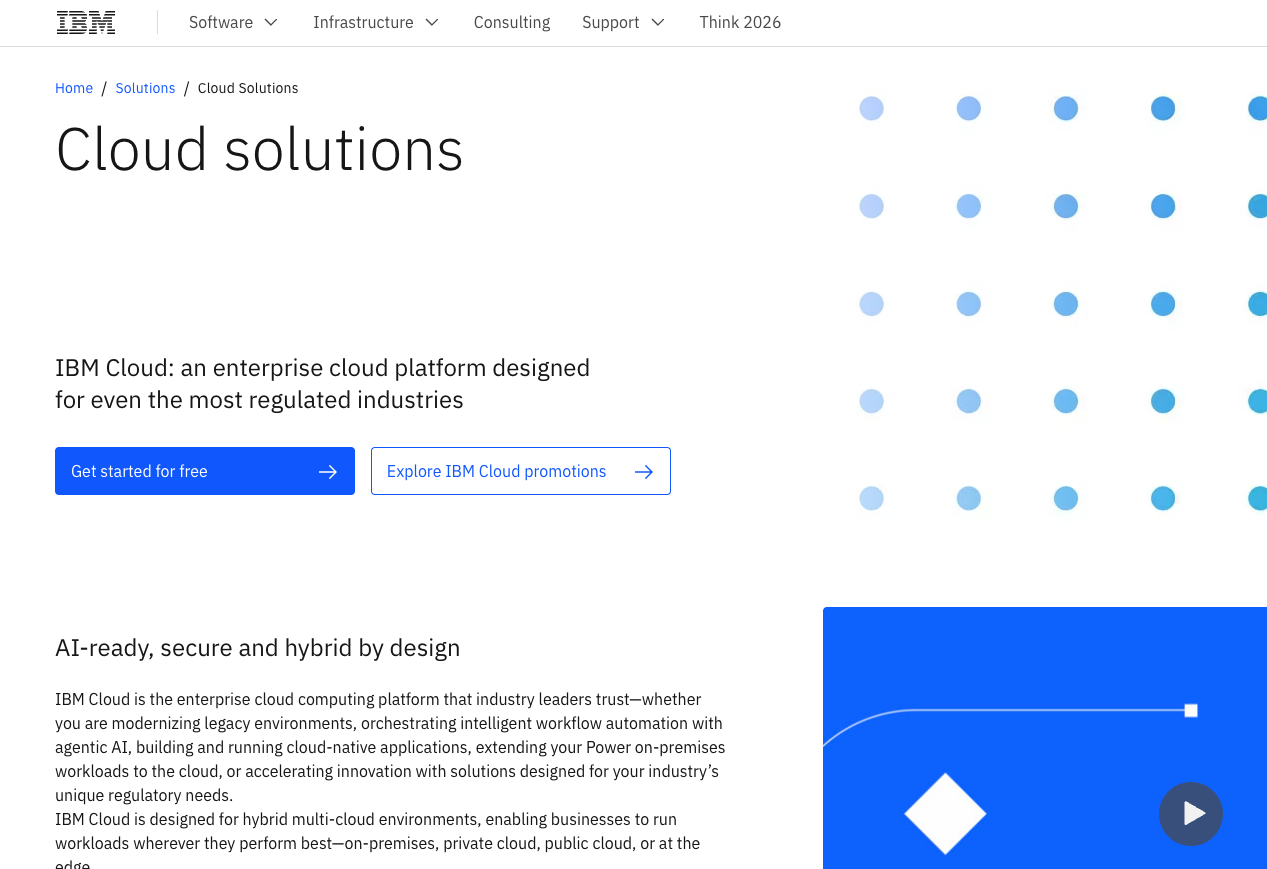
IBM Cloud holds under 5% of the global cloud market. That figure undersells its relevance for specific use cases.
The acquisition of Red Hat in 2019 transformed IBM Cloud into one of the most credible hybrid cloud platforms in the industry. OpenShift now serves as the foundation for both public and on-premises Kubernetes deployments.
Where IBM genuinely competes is regulated enterprise. The platform offers industry-specific clouds for financial services, healthcare, and government, with compliance and confidential computing features designed to meet the strictest regulatory requirements.
IBM Cloud Satellite extends managed cloud services to on-premises infrastructure, customer data centers, and edge locations.
Watson AI services bring enterprise-grade machine learning, natural language processing, and computer vision to organizations that need explainable AI for regulated decisions.
IBM also operates one of the more mature confidential computing offerings. Hyper Protect Services provide technical controls that even IBM administrators can’t bypass.
Limitations are real. Developer experience lags AWS and GCP significantly. The ecosystem is smaller. For cloud-native startups, IBM Cloud rarely makes the shortlist. But for large regulated enterprises managing hybrid environments, it’s a serious contender.
Key features:
- Red Hat OpenShift integration for hybrid Kubernetes deployments
- Watson AI services for enterprise machine learning and NLP
- IBM Cloud Satellite for managed services on customer infrastructure
- Hyper Protect Services for confidential computing in regulated industries
- Industry clouds tailored for financial services, healthcare, and government
- Strong compliance: FedRAMP, HIPAA, PCI DSS, ISO 27001, SOC 2
Best for: Banking, insurance, healthcare, government, enterprises with significant on-premises infrastructure.
7. Oracle Cloud Infrastructure (OCI)
Best for: Oracle Database workloads and free-tier experimentation
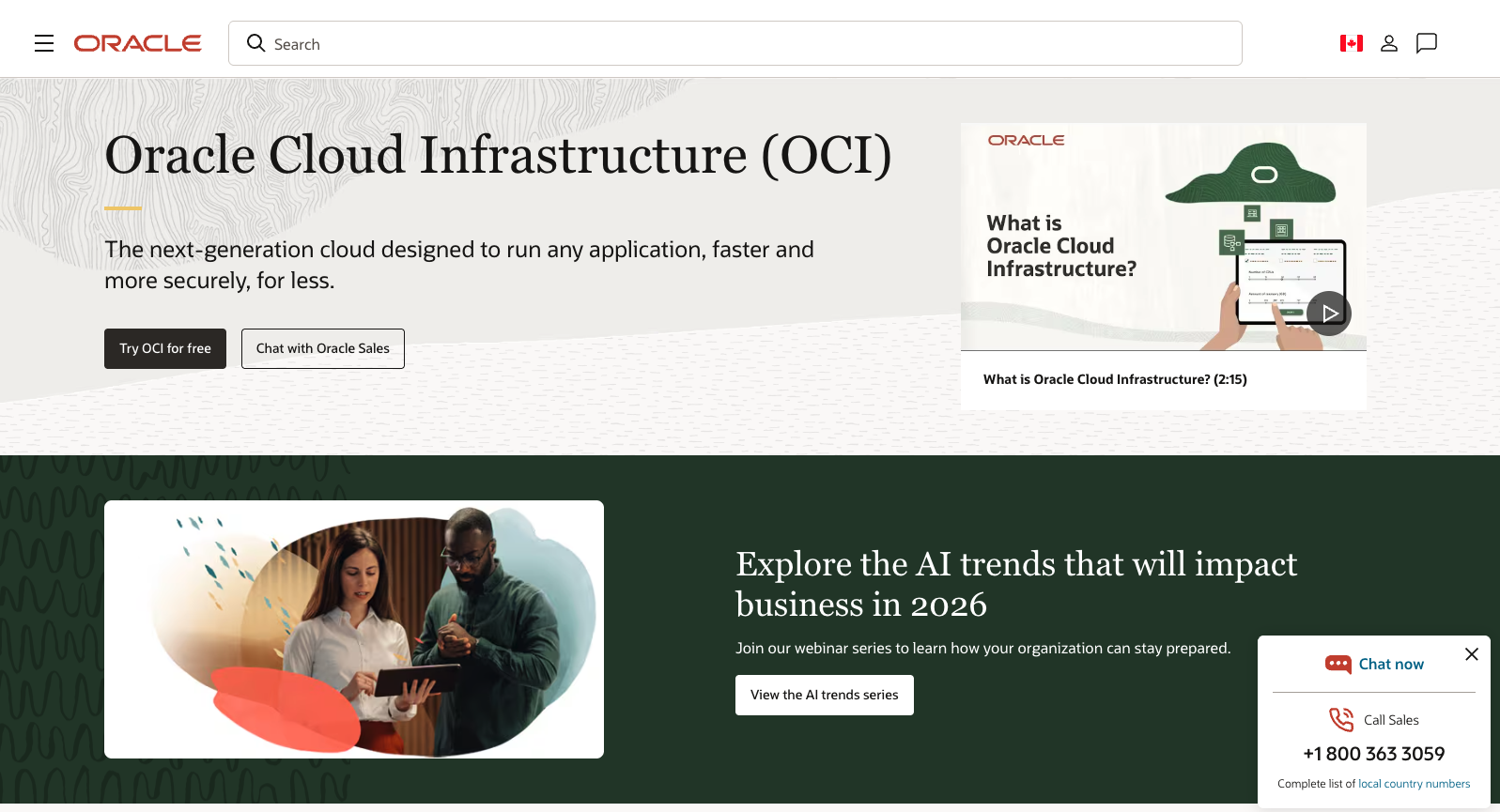
Oracle Cloud Infrastructure has quietly become one of the fastest-growing tier-two cloud providers, alongside CoreWeave and Databricks.
The growth is driven by two things. High-profile AI partnerships (including a major deal to host OpenAI workloads). And continued demand for Oracle’s Autonomous Database, which is genuinely class-leading for enterprise database workloads.
For organizations already running Oracle ERP, HCM, or database software, OCI is the obvious choice. License portability and tight integration with Oracle’s enterprise application stack can dramatically reduce both costs and operational overhead compared to running Oracle workloads on AWS or Azure.
Outside the Oracle ecosystem, OCI competes on two strengths.
Bare metal compute is genuinely excellent. Single-tenant servers without virtualization overhead, available in compute, GPU, and HPC configurations.
The Always Free tier is the most generous in the industry: two AMD VMs, four ARM-based Ampere A1 instances (up to 24GB RAM and 200GB storage), and managed databases. All free indefinitely, not just for a trial period.
The platform’s main weakness is breadth. OCI has fewer regions than AWS, Azure, or GCP. Third-party integrations and the developer ecosystem lag behind. But for Oracle-heavy enterprises and developers who want a real free tier for prototyping, it’s a strong option.
Key features:
- Oracle Autonomous Database, self-tuning, self-securing, self-repairing
- Most generous Always Free tier in the industry (4 ARM VMs, 200GB storage, indefinite)
- Bare metal compute with no virtualization overhead
- Native integration with Oracle ERP, HCM, and enterprise applications
- Strong compliance: FedRAMP High, SOC 1/2, HIPAA, PCI DSS, ISO 27001
- Major AI partnerships including OpenAI infrastructure hosting
Best for: Enterprises running Oracle ERP/HCM, database-heavy applications, developers wanting a real free tier.
8. Tencent Cloud
Best for: China market access and gaming infrastructure
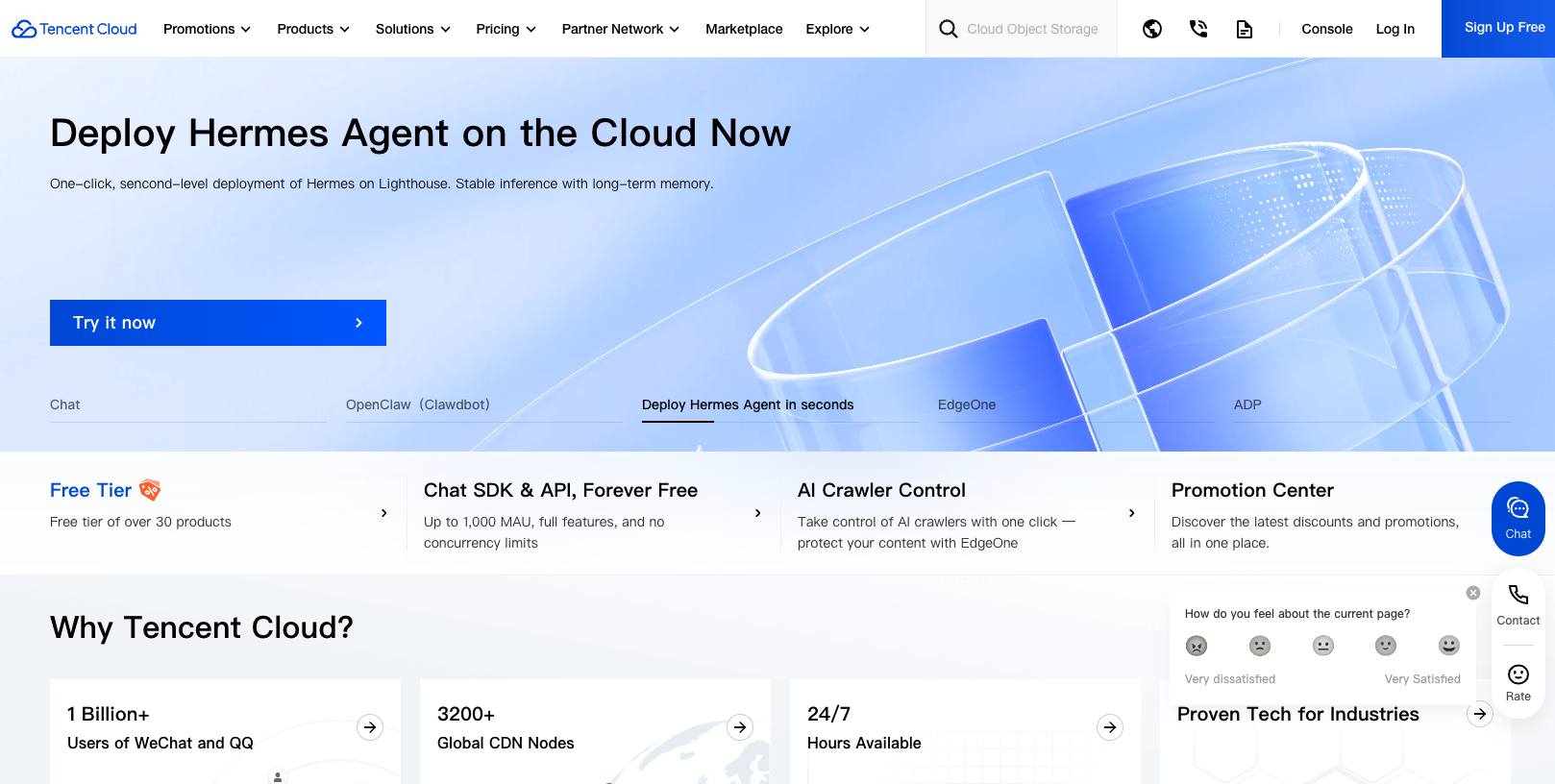
Tencent Cloud held roughly 15% of China’s cloud market in late 2024, second only to Alibaba Cloud in the region.
The platform is backed by Tencent’s own gaming, social media (WeChat), and streaming infrastructure. Operations that handle some of the largest concurrent user bases in the world.
That heritage shows in the product. Tencent Cloud’s gaming infrastructure is genuinely battle-tested, with low-latency networking, anti-DDoS protection scaled for global esports tournaments, and game-specific PaaS offerings like GME (Game Multimedia Engine) for in-game voice and chat.
For media and entertainment workloads, Tencent Cloud’s CDN coverage in Asia is among the best available.
Outside of gaming, Tencent Cloud offers the standard IaaS lineup. Cloud Virtual Machine (CVM), Cloud Object Storage (COS), and managed databases at competitive prices.
AI and machine learning services come through Tencent AI Lab, with strong support for Chinese-language NLP that Western providers can’t match.
For Western businesses, Tencent Cloud’s main draw is China access. WeChat Mini Program integration, ICP licensing support, and direct relationships with Chinese consumers are difficult to replicate using Western cloud providers.
Key features:
- Battle-tested gaming infrastructure used by Tencent’s own platforms
- Strong APAC CDN coverage with low-latency edge locations
- Cloud Object Storage (COS) and Cloud Virtual Machine (CVM)
- Tencent AI Lab with class-leading Chinese-language NLP capabilities
- WeChat Mini Program integration and ICP licensing support
- Game Multimedia Engine (GME) for in-game voice and real-time communication
Best for: Gaming companies, media platforms, businesses serving Chinese consumers, real-time communication apps.
9. DigitalOcean
Best for: Startups, developers, and small businesses
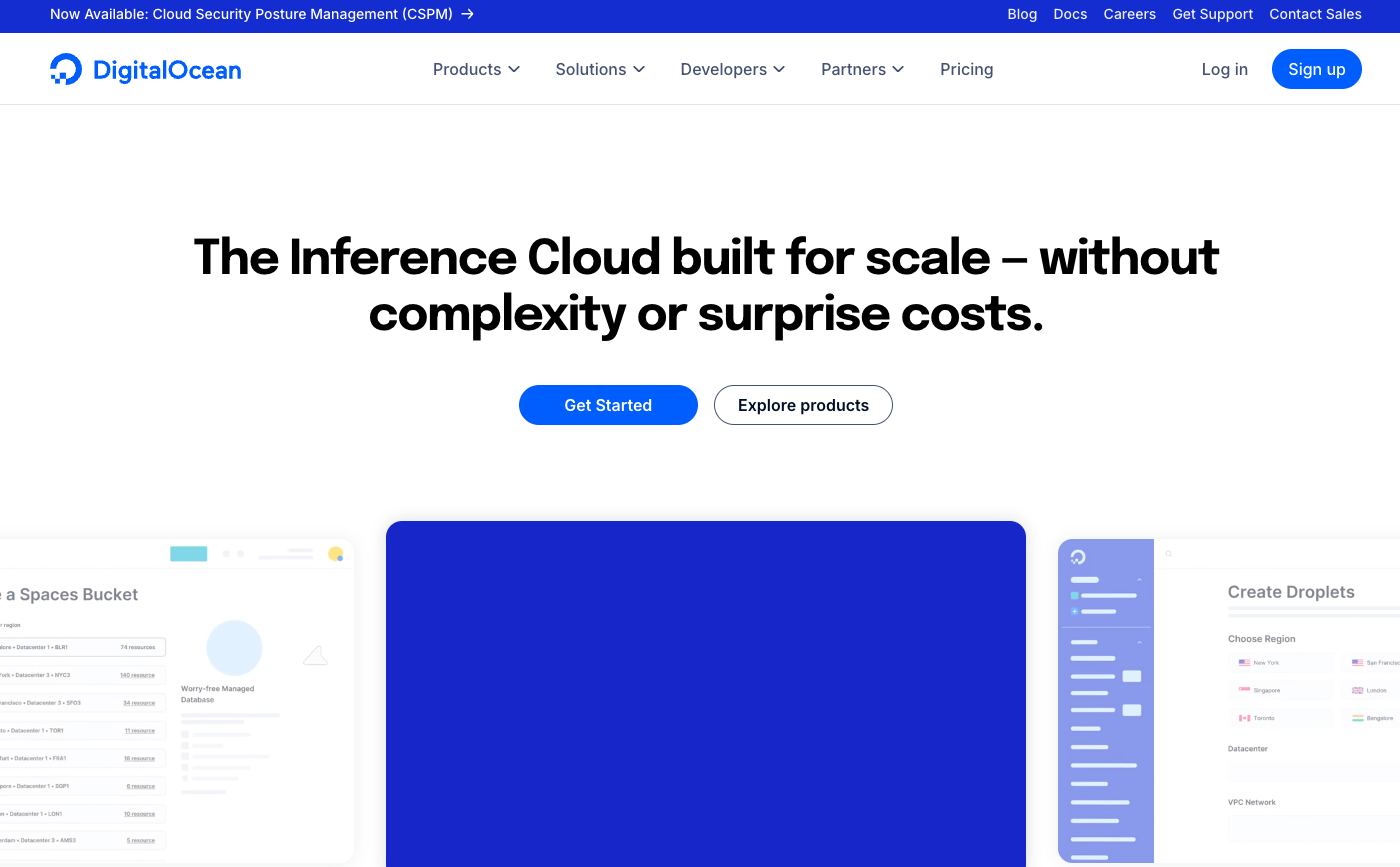
DigitalOcean is the most developer-friendly cloud platform on this list.
Where AWS demands a steep learning curve and Azure assumes enterprise context, DigitalOcean’s entire platform is built around the assumption that you want to spin up a server in 60 seconds and get back to building something.
The core offering is Droplets, which are virtual machines with predictable flat-rate plans and no surprise egress fees.
Beyond compute, the platform covers managed databases (PostgreSQL, MySQL, Redis, MongoDB, Kafka), Spaces for S3-compatible object storage with a built-in CDN, and App Platform for git-based deployment of containerized apps.
DigitalOcean Kubernetes (DOKS) handles orchestration for teams ready to move beyond single-server deployments.
DigitalOcean has been investing heavily in AI. GPU Droplets are now available for inference and fine-tuning workloads. The Paperspace acquisition in 2023 added serious GPU infrastructure to the platform, making it credible for AI startups that don’t want to deal with AWS pricing.
Documentation and community resources are genuinely excellent. DigitalOcean’s community tutorials are some of the most-cited Linux and DevOps references on the internet.
The trade-off is breadth. For very large-scale or highly complex workloads, you’ll eventually outgrow DigitalOcean. But for the first several years of most startups, it’s hard to beat.
Key features:
- Droplets with predictable flat-rate plans and no surprise egress fees
- Managed databases: PostgreSQL, MySQL, Redis, MongoDB, Kafka
- Spaces object storage with S3-compatible API and built-in CDN
- App Platform for git-based PaaS deployment
- GPU Droplets for AI inference and fine-tuning (via Paperspace)
- Industry-leading documentation and community tutorials
Best for: Startups, freelancers, indie developers, small and medium businesses, AI prototyping.
10. Vultr
Best for: Global low-latency hosting with bare metal options
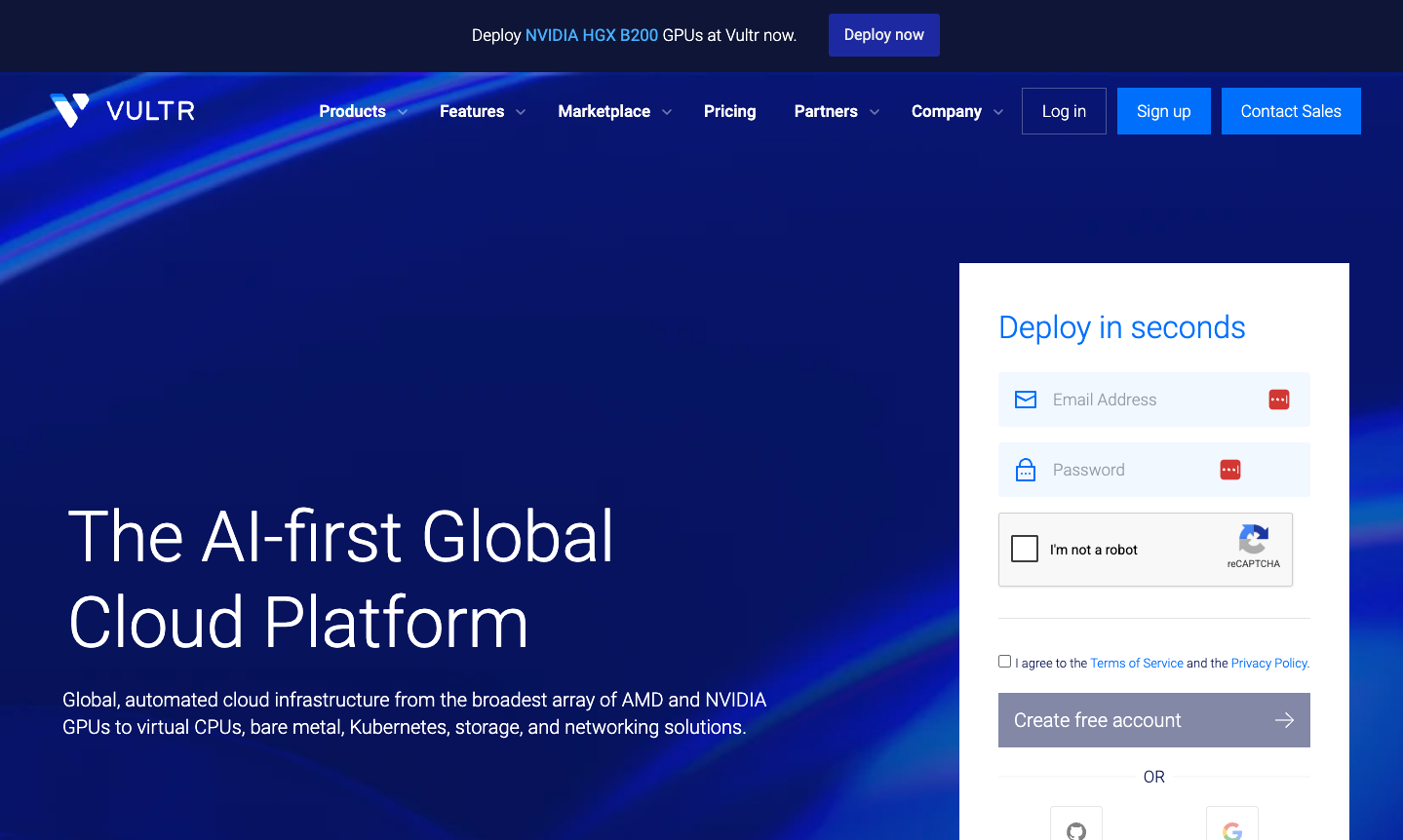
Vultr competes directly with DigitalOcean and often wins on hardware variety and global reach.
With 32 data centers spread across six continents, it has one of the largest geographic footprints among independent cloud providers. Useful when you need to deploy compute close to specific user populations to minimize latency.
Where Vultr really differentiates is hardware choice. The platform offers high-frequency compute (3+ GHz CPUs for latency-sensitive apps), bare metal servers (no virtualization overhead), GPU instances (NVIDIA A100, A40, L40S for AI workloads), and standard cloud compute. All under one account and one control panel.
Vultr Cloud GPU has become a real player in the AI inference and training space, particularly for teams that find AWS GPU pricing prohibitive.
The platform also offers managed Kubernetes (VKE), block storage, object storage, and managed databases. It’s a more complete platform than the simple VPS provider it started as.
The control panel is clean and developer-friendly, with full API access and Terraform support. Like DigitalOcean, Vultr won’t be the right choice for organizations needing complex enterprise features. But for technical teams that want flexibility, hardware variety, and global reach without hyperscaler complexity, it’s an excellent option.
Key features:
- 32 data centers across six continents, strong global low-latency coverage
- High-frequency compute, bare metal servers, and GPU instances
- NVIDIA A100, A40, and L40S GPU instances for AI workloads
- Vultr Kubernetes Engine (VKE) for managed container orchestration
- Full API access, Terraform provider, and developer tooling
- Object storage, block storage, and managed databases
Best for: Developers needing global footprint, performance-critical apps, AI inference workloads, bare metal needs.
11. Linode (Akamai)
Best for: A predictable, transparent cloud experience
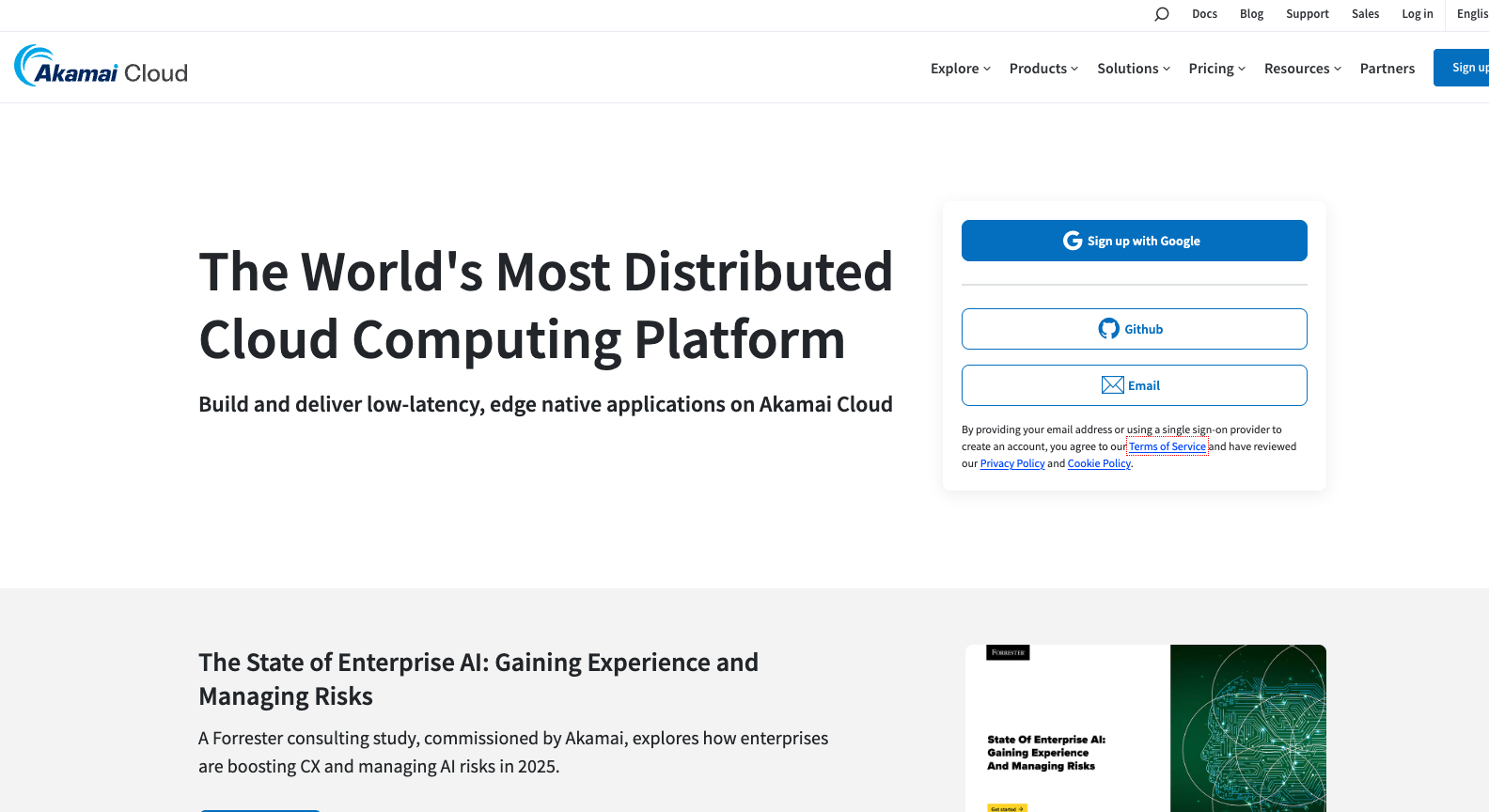
Linode was acquired by Akamai in 2022 and rebranded as Akamai Cloud Computing, though the Linode name persists in product references.
The acquisition gave Linode access to Akamai’s massive edge network, over 4,100 points of presence worldwide, while keeping the developer-focused experience that built Linode’s reputation in the first place.
The core appeal is simplicity. Each instance type comes with a generous bandwidth allowance bundled in, rather than metered separately like AWS.
That makes Linode particularly attractive for bandwidth-heavy applications like video streaming, file hosting, and APIs serving large payloads. When bandwidth overages do occur, the rates are among the lowest in the industry.
Linode’s Cloud Manager is consistently praised for being clean and intuitive. The platform supports the full range of expected services, including managed Kubernetes (LKE), managed databases, object storage, and GPU instances. All without the bloat of 200 overlapping services.
The full API and CLI make it Terraform-friendly and easy to integrate into existing infrastructure-as-code workflows.
The Akamai acquisition has accelerated investment in edge compute and security services, with new Akamai-integrated offerings for DDoS protection and global content delivery.
For developers and small-to-mid teams that want a clean, reliable cloud platform without enterprise overhead, Linode remains one of the best options available.
Key features:
- Generous bandwidth allowances bundled with every instance type
- Clean, intuitive Cloud Manager with full API and CLI support
- Linode Kubernetes Engine (LKE) for managed container orchestration
- Akamai edge network integration for global delivery and DDoS protection
- Managed databases, object storage, and GPU instances available
- Compliance: SOC 2 Type II, ISO 27001, GDPR, HIPAA, PCI DSS
Best for: Developers and small-to-mid teams who want simple cloud operations without enterprise complexity.
12. OVHcloud
Best for: European data sovereignty and GDPR-strict workloads
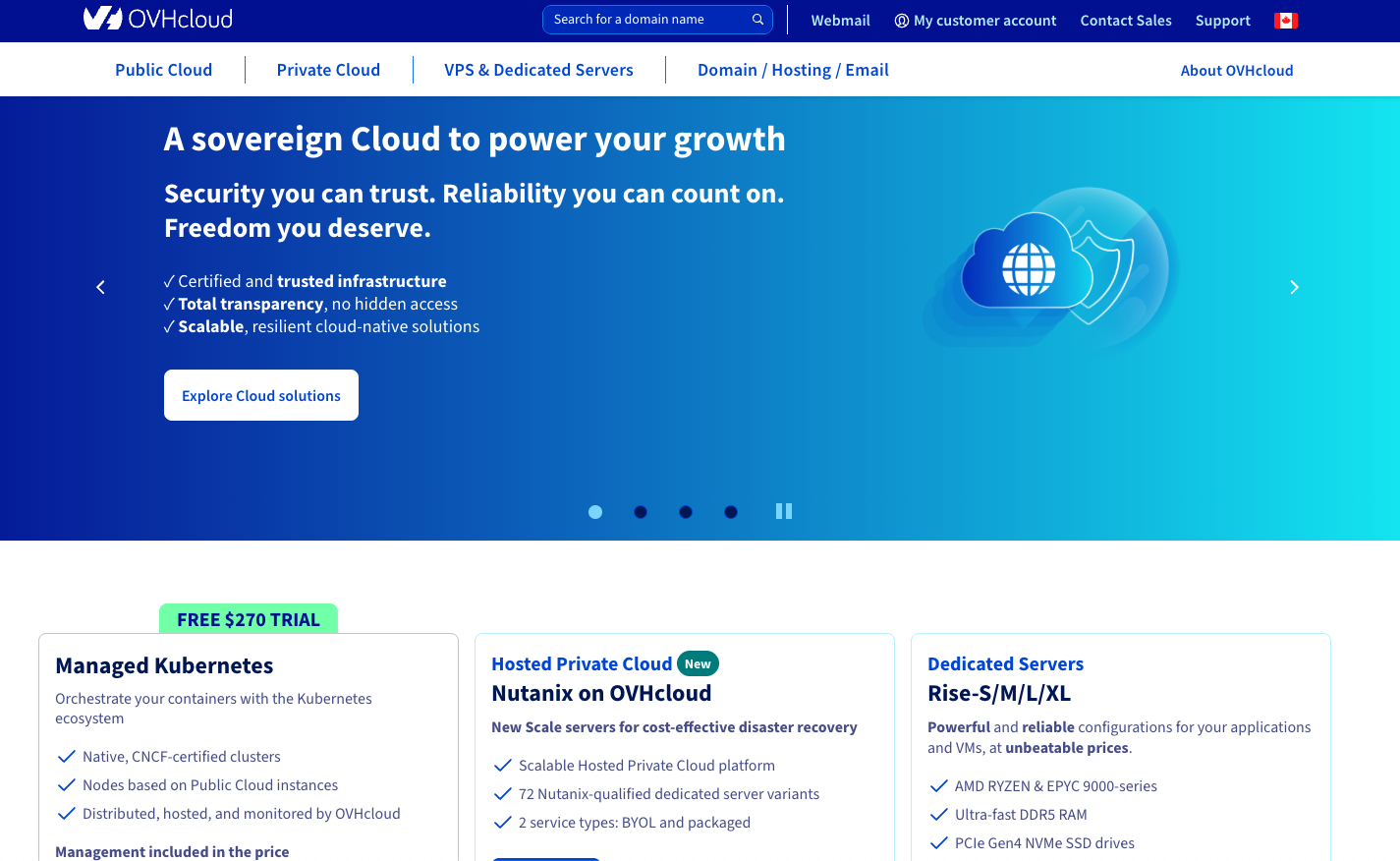
OVHcloud is Europe’s largest cloud provider and the strongest option for businesses that need data residency in the EU or strict GDPR compliance.
Headquartered in France with 30+ data centers across four continents, OVHcloud has positioned itself as the European alternative to US-based hyperscalers.
The platform spans bare metal, public cloud, hosted private cloud, and managed Kubernetes. There’s a particular strength in dedicated and bare metal infrastructure that comes from OVHcloud’s history as a hosting company.
Pricing is generally competitive against AWS and Azure for equivalent workloads, with the added benefit of unmetered bandwidth on many plans.
OVHcloud’s compliance posture is built around European regulatory requirements. The platform holds ISO 27001, SOC 2, HDS (French health data hosting certification), and SecNumCloud (French government qualification). That makes it credible for healthcare, financial services, and public sector workloads in Europe.
The platform isn’t without limitations. Service breadth doesn’t match the hyperscalers, and the developer experience can feel more old-school than modern alternatives.
But for European businesses worried about data sovereignty, the US CLOUD Act, or future regulatory changes affecting US-based providers, OVHcloud is the most credible option in the market.
Key features:
- Europe’s largest cloud provider with 30+ data centers across four continents
- Strong GDPR compliance and EU data residency for regulated industries
- Bare metal, public cloud, hosted private cloud, and managed Kubernetes
- Unmetered bandwidth included on many plans
- Compliance: ISO 27001, SOC 2, HDS (health data), SecNumCloud (French gov)
- Public Cloud and Bare Metal Cloud product families with transparent specs
Best for: European businesses, regulated industries, organizations with EU data residency requirements.
13. Dell Technologies Cloud
Best for: Enterprises running on-premises hybrid cloud with VMware
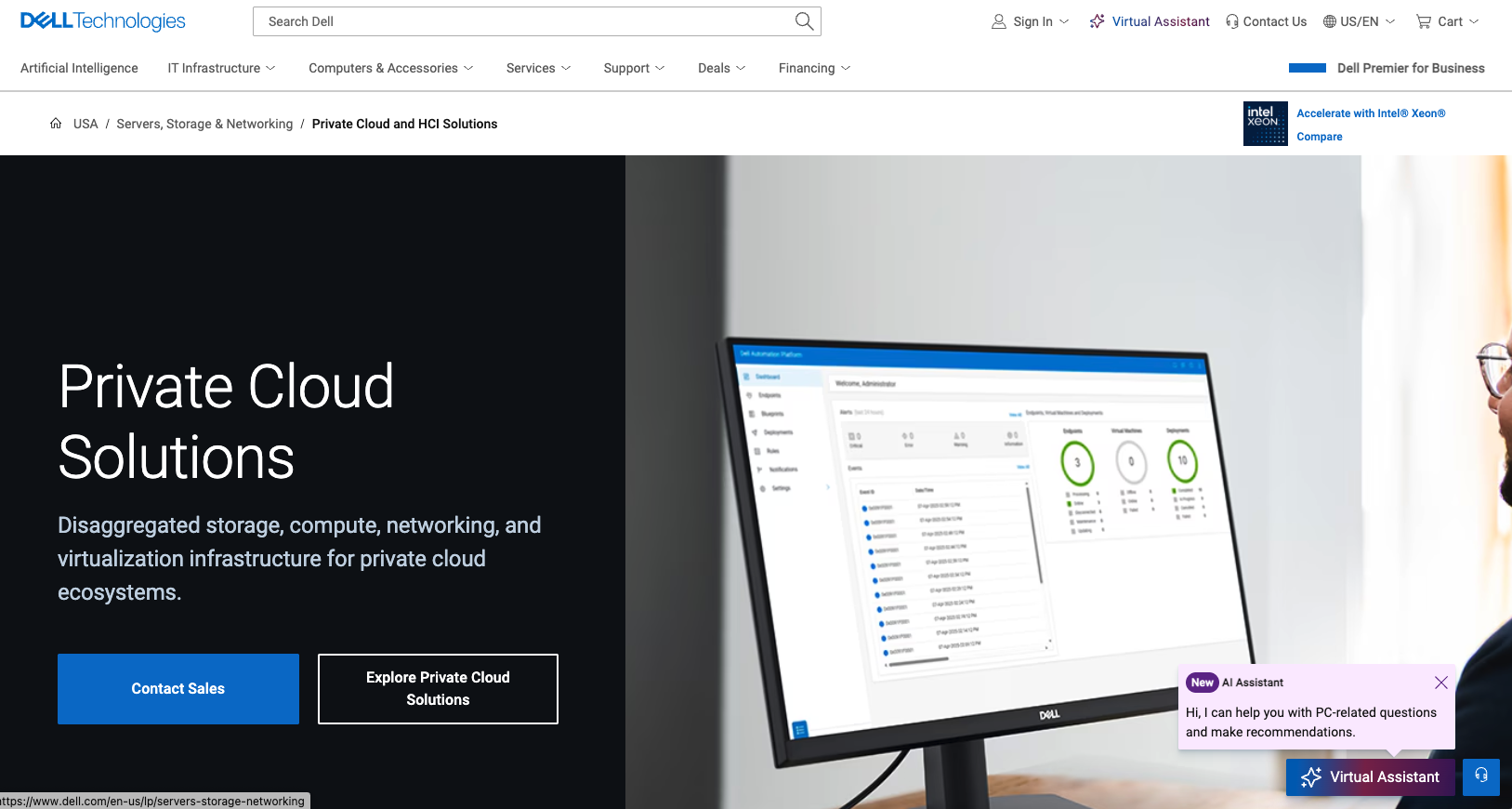
Dell Technologies Cloud isn’t a public cloud platform in the traditional sense.
It’s a portfolio of hybrid cloud solutions, built primarily around VMware Cloud Foundation and Dell APEX, that lets enterprises run cloud-style workloads on their own hardware.
Workloads run in the customer’s own data centers while maintaining connectivity to public clouds like AWS, Azure, and Google Cloud.
The pitch is targeted at large enterprises with significant existing VMware investments that aren’t going anywhere.
Dell APEX delivers infrastructure as a service consumed on a pay-as-you-go basis, but deployed on-premises, in colocation facilities, or at the edge. This bridges the gap between traditional capex hardware purchases and pure public cloud consumption.
For organizations with strict data residency requirements, regulatory constraints that prevent full public cloud adoption, or sunk costs in VMware tooling and team skills, Dell Technologies Cloud provides a credible path forward.
The integration with major public clouds means workloads can shift between on-premises and public cloud as needed without re-architecting.
The model isn’t right for cloud-native startups or organizations looking for hyperscaler-style scale-out elasticity. It’s a hybrid play, with the complexity and consultative sales motion that come with enterprise infrastructure.
Key features:
- VMware Cloud Foundation integration on Dell hardware
- Dell APEX consumption model, IaaS deployed on-premises or at the edge
- Connectivity with AWS, Azure, and Google Cloud for hybrid workloads
- Strong data protection through Dell PowerProtect Data Manager
- Multi-cloud management through APEX Cloud Platform offerings
- Designed for regulated industries and on-premises mandates
Best for: Large enterprises with VMware infrastructure, organizations with on-premises requirements, regulated industries.
How to Choose the Right Cloud Service Provider
The best cloud service provider depends on what you’re building and what constraints you’re working with.
A few quick guidelines:
- Need broad enterprise services and global scale? AWS or Azure.
- Building AI or analytics-heavy workloads? Google Cloud or Vultr (for GPU).
- Want a simple cloud experience without hyperscaler complexity? ServerMania, DigitalOcean, or Linode.
- Operating in Asia or China? Alibaba Cloud or Tencent Cloud.
- Have strict EU data residency requirements? OVHcloud.
- Running Oracle databases? Oracle Cloud Infrastructure.
- Migrating from on-premises VMware? Dell Technologies Cloud or Azure.
Most businesses end up using more than one provider over time.
A multi-cloud setup spreads risk, avoids vendor lock-in, and lets you pick the best platform for each workload.
Frequently Asked Questions
Who are the top 5 cloud service providers?
The top 5 cloud service providers in 2026 are AWS, Microsoft Azure, Google Cloud Platform, Alibaba Cloud, and IBM Cloud.
AWS, Azure, and GCP together control about 63% of the global cloud infrastructure market based on Q3 2025 Synergy Research Group data.
What is the most reliable cloud provider?
AWS, Microsoft Azure, and Google Cloud Platform all offer 99.99% uptime SLAs for core compute and storage services with multi-region disaster recovery.
ServerMania backs AraCloud with a 100% network uptime SLA across its data centers. For most businesses, reliability differences between major providers are negligible in practice.
Which cloud provider offers the best value for small workloads?
DigitalOcean, Vultr, and Linode are consistently ranked among the best value cloud providers for small workloads thanks to their transparent flat-rate plans and developer-friendly experience.
Oracle Cloud also stands out with the most generous Always Free tier of any major provider.
What is the best cloud service to use for small business?
DigitalOcean and ServerMania are the strongest picks for small and medium businesses. DigitalOcean is simpler at the entry level.
ServerMania suits SMBs that need more control, dedicated resources, or compliance certifications without hyperscaler complexity.
Which is the best cloud storage service provider?
Amazon S3 is the industry standard for durability (99.999999999%) and scale. Azure Blob Storage is best for Microsoft ecosystem integration. Google Cloud Storage excels for analytics.
DigitalOcean Spaces and ServerMania offer simpler options without the egress fee surprises.
Final Word
There’s no single best cloud service provider.
AWS, Azure, and Google Cloud lead by sheer scale. But independent providers like ServerMania, DigitalOcean, and Vultr win on simplicity and developer experience.
Match the provider to the workload, not the brand recognition.