
Python has become the language of choice for modern data engineering, automation, analytics, and machine learning. As more organizations build data-driven systems through code, expectations for enterprise software are changing as well.
Developers increasingly want direct programmatic access to the platforms they use every day.
With Release 2026.06, digna is responding to that demand by introducing the digna Python SDK, enabling developers and data scientists to interact with the platform directly through Python.
The SDK transforms digna from a platform accessed primarily through dashboards into a platform that can be integrated directly into code, scripts, notebooks, and automated workflows.
Why a Python SDK Matters
Many data platforms provide powerful functionality through graphical interfaces. While dashboards are valuable for monitoring and administration, developers often need a more flexible approach.
Programmatic access allows teams to:
- automate repetitive tasks
- integrate platform functionality into existing applications
- build custom workflows
- connect observability with engineering processes
The digna Python SDK delivers exactly this capability.
Instead of manually performing actions through the dashboard, users can now interact with the platform through code.
What Can Developers Do with the digna SDK?
The SDK exposes core platform capabilities through Python.
Developers can programmatically:
- create projects
- configure datasets
- configure tables
- start inspections
- retrieve inspection results
- automate observability workflows
This makes it possible to integrate digna directly into existing development and data engineering environments.
For teams already working with Python, this significantly reduces friction and enables new automation possibilities.
Integrating Observability Into Data Pipelines
Modern data environments are increasingly automated.
Data pipelines, orchestration systems, and processing workflows are often managed entirely through code.
With SDK access, observability no longer needs to sit outside those processes.
Developers can incorporate monitoring and inspection activities directly into automated workflows, ensuring that observability becomes part of the pipeline itself rather than an external activity performed afterward.
This creates a more seamless relationship between engineering, monitoring, and data quality.
A New Opportunity for Data Scientists
The SDK is not only relevant for developers.
Data scientists can also benefit from direct access to observability outputs.
Anomaly detection results, validation outcomes, and behavioral metrics generated by digna can provide useful signals when preparing training data or evaluating model inputs.
Through Python, these outputs can be integrated directly into notebooks and machine learning workflows.
This enables teams to use observability information where analytical work is already happening.
Available Through PyPI
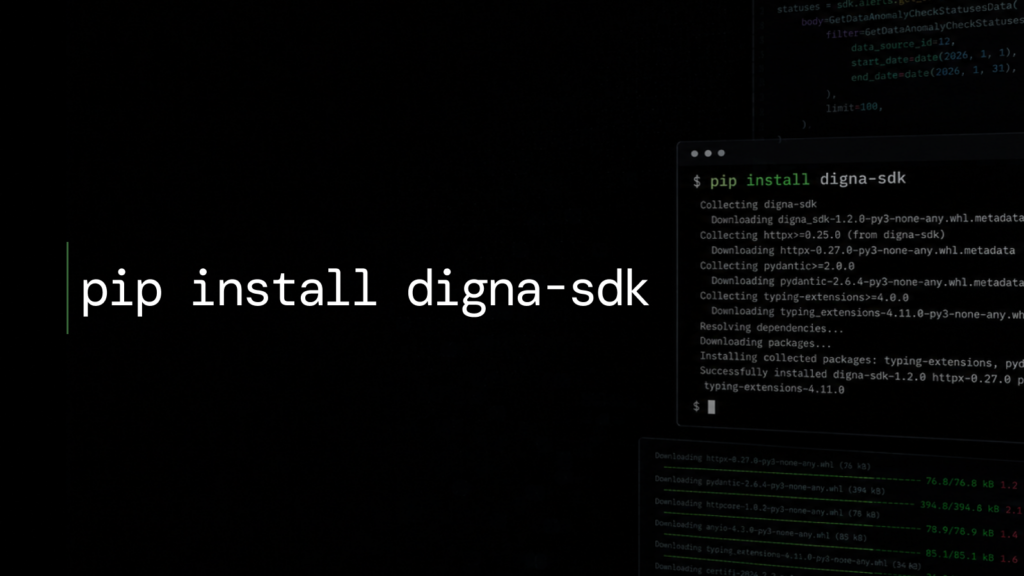
To make adoption simple for Python developers, the digna SDK will be distributed through PyPI (Python Package Index).
This means teams can install and manage the SDK using familiar Python package management workflows.
Built for Modern Engineering Teams
The introduction of the Python SDK reflects how modern teams work.
Developers increasingly expect infrastructure, monitoring, and data platforms to provide programmatic access alongside graphical interfaces.
By extending digna into Python, the platform becomes easier to integrate into development environments, automation frameworks, and analytical workflows.
The result is greater flexibility, deeper integration, and new opportunities to use observability as part of everyday engineering processes.
Learn More
The digna Python SDK is available as part of Release 2026.06. Read the full release notes